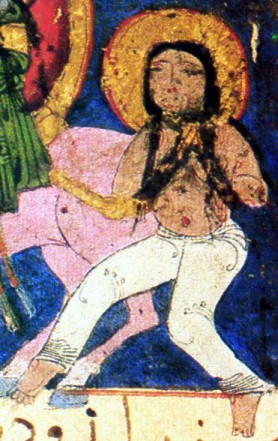
| There are two types of trousers that are likely to have been worn. The first is the outer trousers and the second is the under trousers. Illustrations from the Varqa and Gulshah sage so trousers which are loose fitting but not perticularly baggy and reached beyond the ankle. Of course, the degree of bagginess varied between cultures, places and with a persons status and wealth. | The most common colours and patterns are whites (see figure 1), solid colours or stripes (see figure 2). There are some pictures which show highly patterned fabrics but these could be just artistic licence. Equally they may not be as several fabric pieces have ornate designs though none of them are associated with clothing. The last thing is the a draw string to hold the trousers at the waist. This was a cord or possibly in some cases a sash. I have found no references to what the cord was made of but one found on a 14th Century Nubian bishop was suppossedly rather like modern pyjama cord. |
 |
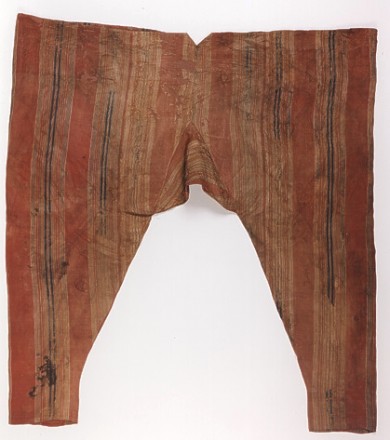 |
| Figure 1 - Trousers as worn by Varga after he was captured. | Figure 2 - Egyptian Trousers dating from 1200-1400 |
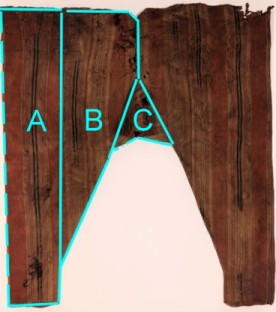
| While the trousers shown in figure 2 have no direct link with Turkish nomads they are with in the period and region. They are also detailled enough to come up with a pattern for making trousers. As you can see in Figure 3 there are 3 main pieces (one of part A and two of part B) to make up one side, which is then duplicated for the other side. With finally one more piece (part C) added at the crotch to take out some of the stress and tension that would be present in that area and cause seams to rip. The dashed line down the side indicates the fold line of the original fabric. Based on some rough calculations (the width of the trousers is listed as 80cm) I would say the original fabric was roughly 34cm wide. The basic pattern I came up with is as follows:
Another point of interest with these trousers is the waistband instead of being a separate piece of fabric that we can see in later nomadic trousers(aka Tilke)this waistband is an integral part of the trousers. In fact it has been fold in to form the waistband loop to thread the cord through. The opening is just a V-notch created by folding back the fabric and not sewing them together. | If you want to see more detailled images of these trousers go to the Brussels Royal Museum of Art and History.
|
| Now as to under trousers. They are to a certain extent a mystery and possibly a misnomer. We have pictures such as those from the pseudo-Galen manuscript and others which show a knee length white trouser. Equally we have from the same picture men wearing nothing around their nether regions. In fact a 13th Century document states that workers working on the upper storeys of a building must wear some form of breech clout or trousers. Also, none of these pictures can be said to be of steppe nomads so it is hard to say if they wore them or not. If under trousers do exist as a separate category then they would seem to be loose fitting, knee length and made of a white material. Essentially the same as outer trousers just shorter. | An alternative possibilty is that under trousers as a category do not exist. What the nomads might have done during the hot summer is wear a single pair of trousers. On cold nights or during winter they may have worn many pairs of trousers. If this was the case then they would probably put the oldest or worst pair on first and put the better quality trousers on last so that only their best was showing. This would mean that a single pair of trousers could be both under and outer trousers depending on the circumstances. |